Tai Chi for Space: A Regulatory Countermeasure Framework for Human Adaptation to Altered Gravity
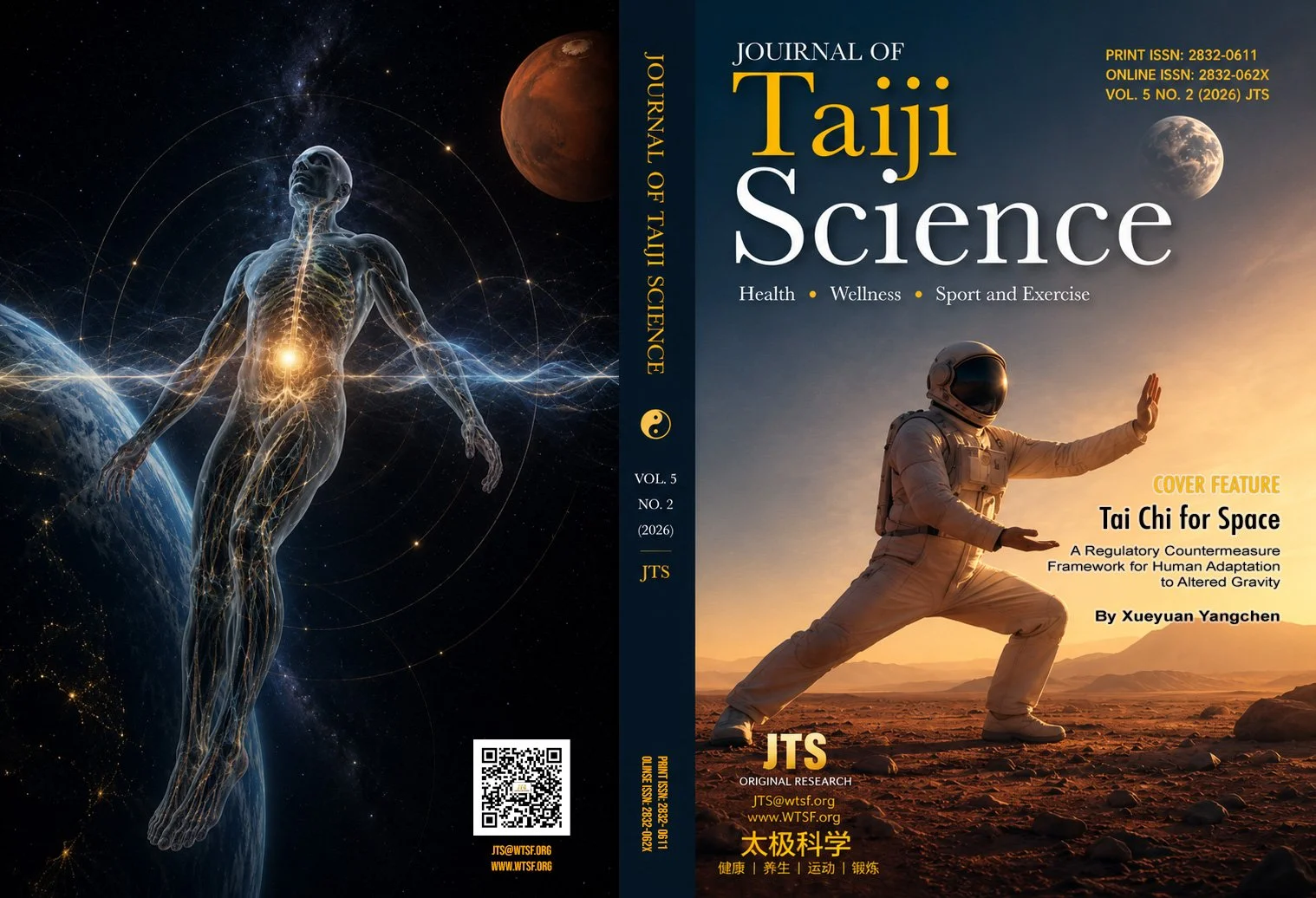
Tai Chi for Space: A Regulatory Countermeasure Framework for Human Adaptation to Altered Gravity
By Xueyuan Yangchen
Keywords:
Tai Chi, Taiji, Altered Gravity, Mars Exploration, Sensori Motor Adaptation, Dynamic Load Regulation, Kinetic-Chain Transmission, Postural Control, Autonomic Regulation, Concept Paper, Space Medicine
Abstract
Human exploration of the Moon and Mars will depend not only on propulsion, habitats, robotics, and life-support systems, but also on the capacity of the human body and mind to remain coordinated, oriented, and emotionally regulated when gravity changes. Altered gravity disrupts body loading, posture, gait, sensorimotor integration, autonomic regulation, movement confidence, and operational performance. Exercise is already a cornerstone countermeasure in space medicine, yet current systems remain resource-intensive and do not fully eliminate multisystem deconditioning. This concept paper argues that Tai Chi deserves rigorous study as a complementary, low-resource regulatory countermeasure for human adaptation to altered gravity. Its central contribution is to translate selected Tai Chi principles into testable movement-science hypotheses: the lower-body principle of empty-full transition as dynamic load regulation; the upper-body principle of sequential kinetic-chain transmission as proximal-to-distal operational control; and the broader training state of low-tension stability as integrated regulation of posture, breath, attention, and muscle tone. Tai Chi is not proposed as a substitute for aerobic or resistive exercise. Rather, it is proposed as a compact integrative model that may complement existing countermeasures by training dynamic balance, whole-body coordination, reaction-force management, spatial trajectory control, breath regulation, attentional control, and psychological steadiness. We compare Tai Chi with yoga, Pilates, resistance training, and conventional balance training; develop a mechanistic model linking Tai Chi principles to measurable outcomes; and outline a staged future testing framework using terrestrial biomechanics laboratories, partial-unloading analogs, head-down bed rest or dry immersion, mission-relevant functional tasks, and eventually space-relevant translation studies. Candidate outcomes include center-of-pressure stability, center-of-mass control, plantar pressure, electromyographic coordination, movement smoothness, contact-force stability, heart-rate variability, psychological stress, movement confidence, and operational performance. A preliminary Tai Chi Adaptive Response Index (TARI) is proposed as a transparent composite framework for future studies. By making an ancient mind-body practice measurable without reducing it to a single variable, this paper offers an innovative but scientifically bounded framework for asking whether Tai Chi can help human beings move more wisely in the unfamiliar gravitational worlds they seek to explore.
Author Biography
Xueyuan Yangchen, Independent Researcher
Independent Researcher, La Puente, California, USA
