

Kung Fu Is Not What You Think: The Ancient Art of Becoming
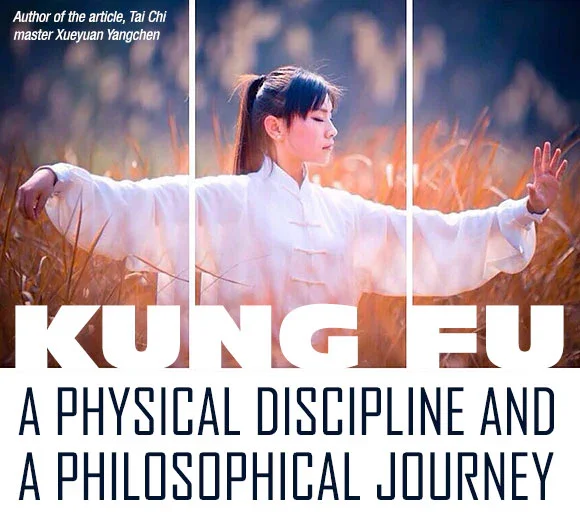
xueyuan yangchen
When many people hear the words Kung Fu, their imagination immediately goes to flying kicks, wooden staffs, Shaolin monks, dramatic movie scenes, or someone breaking bricks with one hand.
That is understandable.
Cinema has given Kung Fu a very loud costume.
But the real meaning of Kung Fu is much quieter, deeper, and, in many ways, far more beautiful.
In Chinese, Kung Fu does not simply mean martial arts. It refers to any skill cultivated through time, patience, discipline, and sincere effort. A chef can have Kung Fu. A calligrapher can have Kung Fu. A musician, a doctor, a gardener, a teacher, a mother raising a child, or a person learning how not to lose their temper can all have Kung Fu.
Kung Fu is not merely something you perform.
It is something you become.
It is the slow art of shaping the self.
Perhaps that is why Kung Fu feels so close to philosophy. It asks the same ancient questions that Laozi, Zhuangzi, Plato, and Aristotle each explored in their own works:
How should a person live?
How do we become better?
How do we use strength without becoming violent?
How do we remain soft without becoming weak?
How do we stay ourselves in a world that constantly pulls us away from our center?
Kung Fu begins with movement, but it does not end with movement.
It begins in the body.
Then it enters the breath.
Then the mind.
Then the character.
And eventually, it becomes a way of living.
Respect: The First Lesson Is Not a Punch
In a Kung Fu school, the first lesson is often not a punch, a kick, or a stance.
It is the Baoquan salute — the traditional fist-and-palm salute of Chinese martial arts.
A student offers the Baoquan salute to the teacher.
The teacher returns the gesture.
Students offer it to one another.
Sometimes they perform it before entering the training space or beginning practice.
To an outsider, this may look like a simple martial arts gesture.
But inside this small movement is an entire philosophy.
The Baoquan salute says:
I am here to learn.
I respect the person in front of me.
I also respect the person I am trying to become.
In Chinese martial culture, the Baoquan salute conveys respect, humility, discipline, and self-restraint. One hand forms a fist, representing strength and martial ability. The other hand covers it, reminding the practitioner that power must be guided by courtesy, morality, and control.
This is a powerful image.
Strength is present.
But strength is not allowed to be reckless.
The fist exists.
But it is held by civilization.
In Confucian thought, respect creates order.
In Buddhist practice, respect softens the ego.
In Daoist philosophy, respect allows us to move with the natural rhythm of things rather than constantly forcing our will upon the world.
Even Aristotle would likely understand this. He believed that virtue is not born from words alone, but from repeated action. A respectful person is not someone who once declared, “I respect others.” A respectful person is someone who practices respect again and again until it becomes part of their character.
Kung Fu teaches this through the body.
You offer the Baoquan salute even when you are tired.
You offer it even when you lose.
You offer it even when you disagree.
You offer it before and after practice.
This is not a weakness.
This is civilization placed inside movement.
In daily life, we often forget this. We may win an argument but lose a relationship. We may speak loudly but say very little. We may be correct, yet become unkind in the way we express the truth.
Kung Fu reminds us that strength without respect becomes aggression. Intelligence without respect becomes arrogance. Emotion without respect becomes damage.
When anger rises, a Kung Fu practitioner does not pretend not to feel it. Anger is real. But instead of throwing it into the world like a weapon, one learns to pause.
Breathe.
Feel the heat.
Let the mind return to the body.
Then choose.
This, too, is Kung Fu.
Not every battle needs a punch.
Sometimes the highest Kung Fu is not saying the cruel sentence already sitting on your tongue.
Balance: Laozi’s Water and Aristotle’s Golden Mean
Kung Fu is full of opposites.
Hard and soft.
Fast and slow.
Attack and defense.
Movement and stillness.
Strength and flexibility.
Courage and restraint.
At first, beginners often misunderstand power. They think power means using more force. They tense every muscle, rush every movement, and try to look strong.
But the body quickly tells the truth.
Too much tension makes movement heavy.
Too much softness makes movement empty.
Too much speed destroys control.
Too much caution kills vitality.
The real art lies in balance.
Laozi wrote that softness can overcome hardness. Water is soft, yet over time, it can shape stone. This is not because water is weak. It is because water understands direction, patience, and timing.
Across the world, Aristotle spoke of the Golden Mean — the idea that virtue often lives between two extremes. Courage exists between cowardice and recklessness. Generosity exists between stinginess and wastefulness. True strength exists somewhere between aggression and collapse.
Kung Fu understands this not only as an idea, but as a physical truth.
A good technique is never purely hard or purely soft.
A good fighter is never only aggressive or only defensive.
A good life is never only ambition or only rest.
If you work all the time, life becomes a battlefield.
If you avoid all effort, life becomes stagnant.
If you always give, you may disappear.
If you only take, you may become lonely.
If you always speak, you stop listening.
If you never speak, your heart becomes crowded with unsaid things.
Balance is not a fixed position.
It is a living adjustment.
Like standing on one leg, balance is not stillness. It is made of countless tiny corrections.
A relationship needs Kung Fu.
A career needs Kung Fu.
Healing needs Kung Fu.
Even happiness needs Kung Fu.
In relationships, two people often bring different rhythms. One moves like fire; the other moves like water. One wants answers immediately; the other needs time. One speaks through logic; the other speaks through emotion.
Without balance, difference becomes conflict.
With balance, difference becomes music.
Zhuangzi might say: do not force the bird to swim or the fish to fly. Each being has its own nature. Much suffering comes from demanding that others move according to our own shape.
Kung Fu teaches us to observe first.
Where is the force coming from?
Where is the resistance?
When should I advance?
When should I yield?
When should I hold my ground?
When should I step aside?
This is not only martial wisdom.
It is life wisdom.
Patience: Kung Fu Cannot Be Downloaded
Kung Fu is inconvenient for the modern world because it cannot be downloaded.
We live in an age that loves speed.
Fast food.
Fast messages.
Fast success.
Fast beauty.
Fast fame.
Even wisdom is sometimes packaged into ten-second videos.
But Kung Fu refuses to hurry.
You cannot fake a stance.
You cannot borrow another person’s years of training.
You cannot pretend to have balance when your body has not built it.
You cannot perform calmness if your nervous system has never practiced returning to calm.
Kung Fu is honest because the body is honest.
Plato’s famous allegory of the cave describes human beings mistaking shadows for reality. A philosopher is someone who turns around, walks out of the cave, and slowly learns to see the real light.
Kung Fu is also a kind of walking out of the cave.
At first, we may live inside the shadows of our impulses. We think our anger is true. We think fear is identity. We think failure means we are finished. We think talent is everything.
But training slowly reveals another reality.
A person with less talent but more patience may go further than a person with talent but no discipline.
A person who loses today may be quietly building the strength to win later.
A person ignored by others may simply be in the invisible season of growth.
I once heard a story about a student who was dismissed by a coach after only a few lessons because the coach believed he would never win competitions. His body proportions were not ideal. He did not look like the obvious champion. In a world obsessed with quick results, he seemed easy to abandon.
But another coach saw something different.
Not perfection.
Not immediate success.
But enthusiasm.
Persistence.
A small flame that had not gone out.
So the coach continued to train him, even giving private lessons for free. Week after week, correction after correction, the student improved. Less than a year later, he achieved excellent results in competition.
The story could end there as a simple inspirational tale.
But life, being life, added irony.
After the student won, the coach who had once given up on him reportedly claimed credit for training him.
At that moment, one could become angry. One could expose the truth. One could fight for recognition.
And perhaps that would be understandable.
But the deeper Kung Fu is more difficult.
The coach who had truly helped him chose patience.
He understood something ancient:
Time reveals what noise hides.
Laozi might say that the Dao does not argue, yet nothing is left undone.
Zhuangzi might laugh and say that names and credit are often only dust in the wind.
Aristotle might call this the discipline of character.
Plato might say that the truth does not disappear simply because people are still looking at shadows.
Kung Fu is not only the ability to defeat an opponent.
Sometimes, Kung Fu is the ability to not be defeated by bitterness.
Self-Mastery: The Highest Kung Fu Is Not Control Over Others
Many people begin martial arts because they want power.
They want to become stronger, faster, more confident, and less afraid.
There is nothing wrong with that.
But after many years, if they are fortunate, they discover something unexpected:
The highest Kung Fu is not control over others.
It is control over oneself.
To control the fist is not difficult.
To control the ego is harder.
To stretch the leg is not difficult.
To stretch the mind is harder.
Defeating another person may require skill.
To transform yourself requires a lifetime.
This is where Kung Fu becomes philosophy.
It is no longer only about how high you can kick.
It is about how deeply you can understand yourself.
Can you stay kind when you are powerful?
Can you stay humble when you are praised?
Can you stay calm when misunderstood?
Can you keep practicing when no one is clapping?
Can you continue doing the right thing when someone else takes the credit?
That is Kung Fu.
Kung Fu as a Way of Living
The longer I understand Kung Fu, the less I see it as something limited to a training hall.
Kung Fu is in how we speak when we are upset.
Kung Fu is in how we begin again after disappointment.
Kung Fu is in how we treat people who cannot benefit us.
Kung Fu is in how we hold our posture, our emotions, our promises, and our dreams.
A person can practice martial arts for years and still have no real Kung Fu in life.
Another person may never wear a uniform, yet show deep Kung Fu through patience, kindness, discipline, and wisdom.
This is why Kung Fu is so fascinating.
It begins with the body, but it does not end there.
It enters the breath.
Then the mind.
Then the character.
Then the way we live.
In the end, Kung Fu is not about becoming invincible.
It is about becoming more complete.
More balanced.
More awake.
More respectful.
More patient.
More able to meet the storms of life without losing the center of oneself.
Perhaps Zhuangzi would call this freedom.
Laozi might call it returning to the Dao.
Plato might call it turning toward the light.
Aristotle might call it the cultivation of virtue.
I simply call it Kung Fu.
So when someone asks me, “What is Kung Fu?”
I no longer think only of martial arts.
I think of time.
I think of character.
I think of falling and rising.
I think of the quiet dignity of practice.
I think of the long road between who we are and who we are capable of becoming.
That road is Kung Fu.
And whether we know it or not, every day, in one way or another, we are all practicing.
By Xueyuan Yangchen
